AncestryDNA uses a saliva sample to analyze your DNA and deliver results.
Because your results depend on the saliva sample you provide, follow the steps below when collecting your sample.
-
Before collecting your sample, register your kit so we can process your sample and know where to deliver your results.
-
Before spitting into the tube:
-
Prepare your mouth.
-
Brush your teeth or use mouthwash.
-
Don’t eat, drink, smoke, or chew gum or tobacco for 30 minutes afterward.
-
If you wear dentures, leave them in.
-
Help produce saliva.
-
Gently rub your cheeks from the outside (pressing them against your teeth and gums).
-
If needed, place ¼ teaspoon of white table sugar on your tongue.
-
Smell or think about something sour (for example, a lemon).
-
Avoid deep throat clearing to produce saliva, as this can make saliva too thick to process at the lab.
-
Spit into the tube until your saliva (not bubbles) reaches the wavy black line. Bubbles can go above the line, but do not overfill the sample.
Fill the tube until saliva (not bubbles) reaches the top of the black line. It’s fine for bubbles to extend above the line. The stabilizing fluid in the tube protects the sample. Over-filling or under-filling the tube can mess up the ratio of saliva to stabilizing liquid.
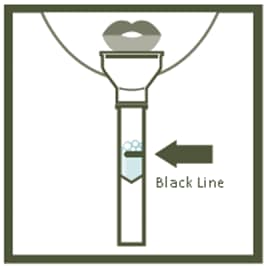
Only human saliva should go into the tube. Samples that contain anything other than saliva won’t be processed.
The blue stabilizing fluid protects the DNA in your saliva. Filling above or below the line can affect the balance between saliva and the stabilizing fluid you’ll add in the next step.
If you have trouble producing enough saliva in a single attempt, try the tips above to help produce saliva. Then, if still needed, you can:
-
Remove the funnel from the tube and replace it with the cap that contains the blue stabilizing fluid, which helps preserve your DNA.
Do not drink the fluid in the lid. Wash with water if the blue stabilizing fluid comes into contact with your skin, eyes, or mouth.
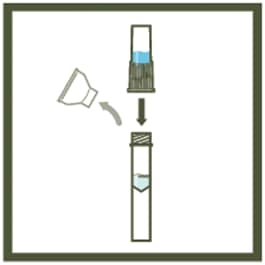
Do not drink the fluid in the lid. If the blue stabilizing fluid comes into contact with your eyes, mouth, or skin, rinse with water.
-
Twist the cap tightly until the blue stabilizing fluid releases into the tube.
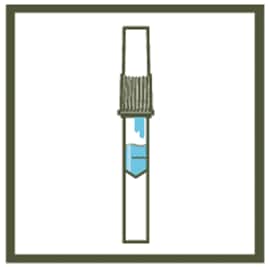
-
Shake the tube for five seconds to mix your saliva with the blue fluid.
-
Place the tube in the collection bag that came with the kit and seal the bag.
-
Put the collection bag in the return mailer, then mail it.
For more details about shipping your sample, read AncestryDNA Shipping.
If you’ve registered your kit, in most cases you’ll receive your results within 6 weeks from the date we receive your sample.
If a sample doesn’t meet quality standards during testing, you may be offered a replacement kit. To learn more, read Why a DNA Sample May Fail.
Frequently asked questions
Select a question below to view the answer. Select the question again to hide it.
What should I do if I have trouble producing enough saliva at once?
If you have trouble producing enough saliva at once, add saliva in stages and keep the tube upright in the refrigerator between attempts until it reaches the fill line. Saliva can be refrigerated for up to one week before adding stabilizing fluid.
Tips to help produce saliva:
- Gently rub your cheeks from the outside (pressing them against your teeth and gums).
- If needed, place ¼ teaspoon of white table sugar on your tongue.
- Smell or think about something sour (for example, a lemon).
- Avoid deep throat clearing to produce saliva, as this can make saliva too thick to process at the lab.
What if the blue stabilizing fluid doesn’t drain into the tube?
If you close the tube and the blue stabilizing fluid doesn’t release:
- Loosen the cap and then tighten it again.
- Screw it on tighter until the fluid drains into the bottom of the tube.
What if my kit or sample is old?
Even if some time has passed since you collected your sample, we still recommend sending it back, as long as your saliva was mixed with the stabilizing fluid.
If it doesn’t meet quality standards, you may be offered a replacement kit.
Can I take the DNA test if I’m sick or taking antibiotics?
Yes. Being sick or taking antibiotics usually won’t affect your DNA results. Antibiotics don’t change your DNA.
However, if you have a very dry mouth or trouble producing saliva because of an illness or medication, it may help to wait until you’re feeling better so you can provide enough saliva and reduce the chance of contamination.
Can I submit a saliva sample if I’m pregnant?
Yes. Pregnancy doesn’t affect AncestryDNA results. You can submit a saliva sample while pregnant without changing the accuracy of the results.
Can I take the DNA test if I’m currently undergoing chemotherapy?
We recommend waiting until chemotherapy treatment is complete before collecting and submitting a saliva sample.
Chemotherapy can affect the amount or quality of DNA in saliva, which may increase the chance that a sample doesn’t meet quality standards during testing. If that happens, you may be offered a replacement kit.
To learn more, read Why a DNA Sample May Fail.
Can I submit a saliva sample for a deceased family member?
We’re unable to process saliva samples that are collected after someone has passed away.
In some cases, a saliva sample that was collected while the person was alive, properly sealed with the stabilizing fluid, and registered to their account may still be submitted and processed. However, we can’t guarantee the sample will work. DNA quality can be affected by many factors, including how and when the sample was collected and its condition at the time of testing.
If you’d like to learn more about your family’s DNA and history, you can still make progress by:
- testing other biological relatives, especially those closely related to them
- building a family tree
- using DNA matches and records to explore shared family history.
Do you offer DNA tests that use blood, hair, or cheek swabs?
We only process DNA from human saliva samples collected using an AncestryDNA kit and the supplies included with it.
We don’t offer DNA testing using:
- blood
- hair
- mouth or cheek swabs
- urine
- non-human samples
- other materials
Does AncestryDNA tell me my blood type?
No. AncestryDNA results don’t include blood type.
AncestryDNA focuses on genetic markers used for ancestral origins (including regions and journeys), DNA matches, and genetic traits. Blood type isn’t included in these results.